Ian Kerner’s So Tell Me About the Last Time You Had Sex was such a fun and informative read! The author gives a vast survey of research on sex and sexual behaviors organized around a sex script. The idea goes that if two people (or just you, with yourself!) are generally aware of what to expect during sex, it becomes easier to add variety or flair safely and timed appropriately. This “safety within boundaries” allows you to develop as many scripts as you want. Kerner doesn’t think we should have just one! If you’re looking to deepen your sexual enjoyment, check out the below image of Kerner’s model and included activities.
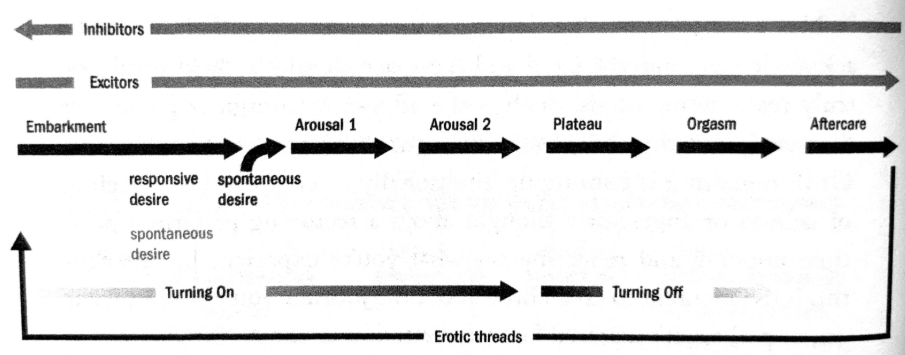
Decreasing inhibitors and increasing excitors, “turning the Offs off and On’s on”, as Emily Nagoski would say.
Check out her resources here for a thorough reflection activity.
Embarkment is your willingness or motivation to even consider “getting on the ride.” This could be based on your personal reasons for and definitions of sex.
- Do any of these sound like your reason?
- Connection
- Excitement, aliveness
- Validation
- Physical pleasure
- …and what else?
Having a clearer path to your personal embarkment could allow one’s responsive desire to be more tangible. Responsive desire is the type of desire that needs encouragement: it exists, but might need to be reminded how fun, pleasant, and worthwhile sex is, in a noncoercive manner.
Spontaneous desire, alternatively, feels more like a light switch–you know when you’re ready and you’re very ready when you’re ready. You would certainly benefit from a general understanding of your reasons and definitions of sex, but your desire doesn’t necessarily depend on it.
Arousal 1 is less related to genital stimulation and more related to above the neck or waist touching: kissing, touching, massaging, exploring textures, or consuming psychogenic stimulation. Psychogenic (or psychological) stimulation is what Kerner refers to as side by side (consuming an external piece of, say, ethical porn, erotica, etc.) or face to face (sharing of personal fantasies, being watched/watching, role-playing, etc.), all without the addition of a third-party stimulus.
What psychological resources do you (and your partner) use? What might you be willing to experiment with?
Arousal 2 marks the stage of genital stimulation, perhaps through manual or oral stimulation, as well as a deepening of arousal 1 (more passionate kissing, less thoughts and more in-the-moment touching). Notice this is the first time the genitals have been included in the fun.
Let this inspire creativity into your next sex script!
Plateau can be most likened to how sex is portrayed in the media: passion takes over and talking is no longer needed. Notice this is represented to take place more than half way into this chart. Imagine how much more difficult the plateau phase could be to enter into for some if there aren’t well-worn paths or an ease of entering autopilot between two people.
Consider your willingness and interest in giving versus your willingness and interest in receiving.
The orgasm phase looks a multitude of ways:
1) a gradual ascent with a quick decline (most men)
2) gradual ascent, plateau, orgasmic peak, followed by another orgasmic peak and then gradual decline, or
3) gradual ascent, plateau, and a fluttering between plateau and orgasm, followed by a gradual decline.
What style most sounds like you? What style most sounds like your partner? What might this mean about your orchestration of orgasms?
The aftercare phase is when the declines described around orgasm are allowed to be completed together and homeostasis is found again. This is a great time to reconnect with your partner, yourself and the world around you.
Underlying this whole process is the gradual increasing sense of arousal turning on, where you increasingly feel immersed and engaged physically, mentally, and emotionally, which peaks and then is automatically followed by turning off (during the the plateau phase), when you enter into a process of becoming less engaged and more routinized, automatic, primal or outside of your own mind.
So Tell Me About the Last Time You Had Sex provides even more explanation, thought-provoking statistics and engaging activities than I could ever include here. I recommend picking up a copy if this main take away is of interest to you. If this explanation is enough and you’re ready to process your own sex script or if this explanation doesn’t make any sense, reach out! I would love to help you (and your partner) understand, create, and have the freedom to edit your sex scripts.
 Good Therapy Center
Leave a comment